
One venue. Twenty young women. As many gowns signed by the greatest couture houses. A quadrille, Viennese waltzes, a seated dinner, international photographers, an evening lasting until dawn. On Saturday 28 November 2026, Paris hosts the thirty-fourth edition of Le Bal des Débutantes. Since 1992, this bal has reinterpreted an ancient tradition — that of débutante balls, which in Europe and the United States marked the entry of young women into society — to make it a modern rendezvous of French elegance, open to the international world. For our clients who split their year between Saint-Barthélemy and the Mediterranean, the Bal represents a unique moment when Paris offers itself to be read through its most beautiful traditions: couture, jewellery, good manners, conversations written nowhere. Maison Silaïa accompanies the families participating — young débutantes, cavaliers, accompanying parents — with the attention the evening deserves.
Le Bal des Débutantes 2026: three decades of French elegance
The thirty-fourth edition of Le Bal des Débutantes takes place on Saturday 28 November 2026 in Paris. The venue is generally revealed only a month in advance — a tradition that preserves confidentiality and the event’s aura. Previous editions have been held in some of Paris’s most beautiful private mansions and palaces: Hôtel de Crillon, Palais Brongniart, Shangri-La Hotel, Peninsula Hotel, the private salons of the Ritz. Each year, the venue choice participates in the staging.
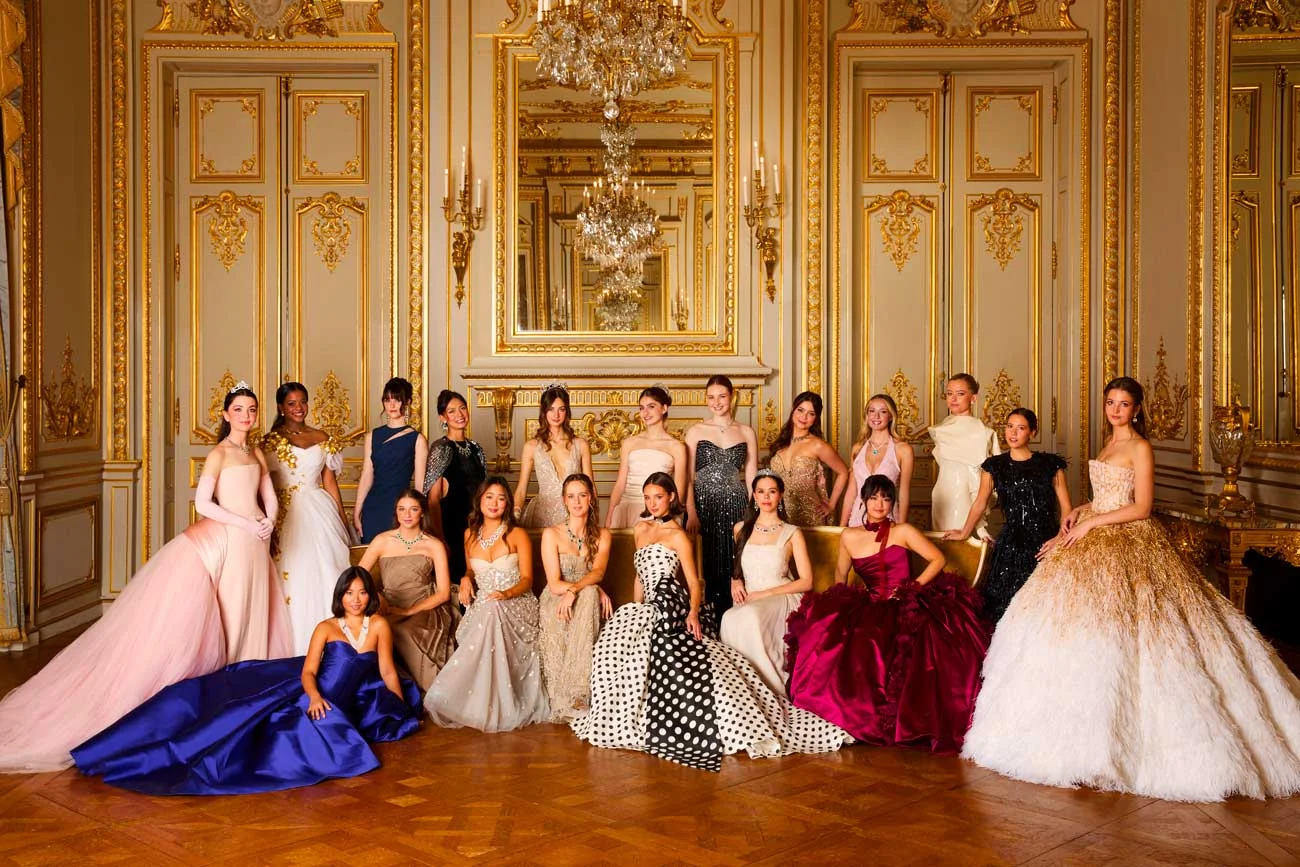
Conceived in 1992 by Ophélie Renouard, the Bal rapidly acquired international stature. Each year, about twenty young women aged sixteen to twenty-two, selected from around the world, participate in this evening. They come from families known in European aristocracy, business, cinema, politics or the arts — daughters of presidents, artists, musicians, fashion designers, heiresses. Each is dressed by a great couture house (Dior, Chanel, Elie Saab, Giambattista Valli, Zuhair Murad, Christian Louboutin, Oscar de la Renta) and adorned with jewels signed by great jewellery houses (Chaumet, Buccellati, Boucheron, Repossi).
The event combines three dimensions. The social dimension — presentation of young women in a traditional but modernised setting. The charitable dimension — the Bal has supported for several years targeted associations, notably Enfants d’Asie. The cultural dimension — each débutante is accompanied by a cavalier, often from another notable family, and the whole forms a small gallery of the contemporary world gathering for an evening.
For our clients from families whose daughter is debuting at the Bal 2026, or for those accompanying a close relative, this evening is one of the rare moments when Parisian life still expresses a form of traditional ritual in its most beautiful version.
The Bal’s origin and spirit
The débutante ball is a tradition dating back to the eighteenth century in England, with Queen Charlotte’s Ball created by George III in 1780 in honour of his wife. Young noblewomen were presented to the monarch, marking their official entry into society. This tradition exported to the United States in the nineteenth century (New Orleans, Atlanta, Philadelphia débutante balls), to Austria (Vienna Opernball), to Germany (Viennese balls), while progressively disappearing in France where the Revolution had broken with aristocratic rituals.
The particularity of the Parisian Bal, reinvented in 1992, is having adapted this tradition without rigidifying it. Modern débutantes are not presented to a monarch — they are presented to an international community of families, fashion houses, prestige photographers, and a broader cultural circle. The age of entry into society has shifted: young women of sixteen to twenty-two are today already present on social networks, in cultural circles, in grandes écoles. The Bal does not present them: it celebrates them in a moment that gathers French elegance, great couture houses, and an international family circle.
This adaptation makes the Bal a living tradition rather than a frozen ceremonial. Each year renews the selection, each edition reflects the state of the world. And each edition maintains the exigency of detail — gowns adjusted by the ateliers themselves, hairstyles signed by the greatest Parisian hairdressers, opening choreography rehearsed for several months before the evening.
« Le Bal des Débutantes is not a mere evening: it is a tradition that makes Paris, each late November, the capital of French elegance. » — Maison Silaïa
The protocol of a unique evening
Understanding the evening’s unfolding and the codes that structure it allows better appreciation of its significance.
Cavaliers, the quadrille, the waltzes
Each débutante is accompanied by a cavalier. Tradition wants this cavalier to be a brother, cousin, close friend — often himself from a notable family. The cavalier-débutante relationship is symbolically important: it embodies the family’s accompaniment of the young woman in this moment.
The evening begins with the protocol arrival of débutantes and their cavaliers before photographers, then with an official presentation in the great hall. An opening quadrille unfolds — collective choreography rehearsed for three weeks before the Bal with a professional dance master. Several Viennese waltzes follow, where each débutante first dances with her cavalier, then with her father. Dinner is then held in the main hall, with seating according to a precise table plan. The evening continues late into the night with music, exchanges, photographs.
Gowns and couture
Each débutante is dressed by a great couture house. The house choice is often linked to a historic relationship between the family and the designer, or to active patronage of a house for the year. Dior, Chanel, Elie Saab, Giambattista Valli, Zuhair Murad, Christian Louboutin, Oscar de la Renta, Carolina Herrera, Alexis Mabille — each year sees the great signatures appear. Gowns are often bespoke creations, made over several weeks in Parisian ateliers, with multiple fittings. The approach is that of a true haute couture order.
Gown choice is made upstream with collaboration of the house, the débutante, and often the mother. It involves constraints (traditionally white or light tones, with increasing chromatic liberty), a personal dimension (the gown must tell something of the young woman), and a photographic dimension (images of the evening will circulate internationally).
Jewels and adornments
In parallel with the gown, each débutante is adorned by a jewellery house. The great Place Vendôme houses — Chaumet, Boucheron, Van Cleef & Arpels, Cartier — and international houses (Buccellati, Graff, Repossi) lend exceptional pieces for the evening. The choice often follows a similar logic to the gown: historic relationship, annual patronage, personality.
The bespoke services we compose include accompanying débutantes and their families in coordination with the houses — appointments for fittings, atelier visits, management of high-value jewellery transport.
Invited families: tradition and renewal
Selecting débutantes is a year’s work for the Bal’s team. Ophélie Renouard and her team receive dozens of applications and recommendations, select about twenty young women according to several criteria: family history, the young woman’s personality, her own approach, the geographic and cultural balance of the edition.
Historically, invited families belong to several worlds: European aristocracy (retired royal houses, noble families of Italy, France, the United Kingdom), entrepreneurial dynasties (founding families of great brands, industrial heiresses), cinema and entertainment (daughters of actors, directors, producers), the arts (families of artists, designers, musicians), politics (daughters of former heads of state).
Each edition renews the balance: Asian débutantes (daughters of great Hong Kong, Singaporean, Indian families), Middle Eastern débutantes (princely families, entrepreneurial dynasties), North American débutantes (heiresses of great American, Latin American families), complete the European circle. It is this diversity that gives the Bal its worldly character and makes it a unique rendezvous.
For families considering their daughter’s participation in a future edition, candidacy can initiate via recommendation from a family already known to the Bal. Dossiers are examined several months in advance.
Paris around the Bal: hotels, restaurants, programming
Le Bal des Débutantes is the central moment of a Parisian weekend that composes well beyond the evening itself. For visiting families, Paris is lived over three to five days.
Accommodation: Parisian palaces
Families participating in the Bal traditionally stay in Parisian palaces, often in family suites. The Ritz Place Vendôme, Le Bristol, Plaza Athénée, Crillon, Le Meurice, Four Seasons George V, Peninsula: the choice often depends on the family’s historic relationship with a hotel, or on proximity to the ateliers of the houses dressing the débutantes. Reservation is made as soon as the Bal date is announced (generally January-February of the year).
Restaurants and gastronomic moments
The Friday evening preceding the Bal often unfolds a more intimate family dinner — at home for Parisian families, or in a reserved restaurant for those from abroad. The following Sunday, a family brunch traditionally closes the weekend, sometimes in the private salons of the palaces, sometimes with a caterer at home. Parisian gastronomic addresses (Ducasse at the Plaza, L’Ambroisie, Arpège, Pierre Gagnaire) book three to four weeks in advance for these moments.
Cultural programme around the Bal
November in Paris offers particular cultural density. Autumn exhibitions are at their peak — major retrospectives at the Louvre, Grand Palais, Fondation Louis Vuitton. The Opera and Comédie-Française are in full season. Right Bank galleries present their autumn hangings. For a family coming from abroad for the Bal, the weekend often composes with two or three cultural moments (private museum visit, spectacle, conference) extending the Parisian experience. The orchestration of these private events is prepared with the same care as the evening itself.
« To participate in the Bal is to inscribe oneself in a lineage — that of young women who, before social networks and saturated agendas, learned to enter society with grace. » — Maison Silaïa
Preparing your visit: the Maison Silaïa method
For families coming to Le Bal des Débutantes, dedicated accompaniment transforms the weekend. We compose each visit according to a five-step method.
A detailed brief six to nine months ahead
Preparation ideally begins in February-March of the Bal’s year. How many family members participate? What are the accommodation needs (family suite, private apartment, or hotel-apartment combination)? Which couture and jewellery addresses are in discussion with the débutante and the selected house? Which family members will attend the evening and who will come for the full weekend?
Accommodation and transfer reservations
The most sought-after Parisian palace suites for the Bal weekend close from March-April. We activate reservations as soon as the brief is validated. Transfers from airport (private jet at Le Bourget or Orly for families arriving by plane), dedicated chauffeurs for the weekend, vehicles for movements to houses (ateliers, fittings, ceremony) prepare in parallel.
Coordination with couture and jewellery houses
Gown fittings take place in Paris generally two to three times before the evening — one in July-August (initial fit), another in October (intermediate fitting), the last in late November (final adjustments). Jewellery visits happen in parallel. We coordinate appointments, transfers, refreshments according to the débutante’s and family’s rhythms.
Cultural programme and weekend restaurants
For a long weekend, we compose the cultural programme (exhibitions, spectacles, private visits) and restaurants per family desires. Gastronomic reservations and private accesses prepare six to ten weeks in advance.
Accompaniment the day of the Bal
The day of the Bal, a coordinator remains reachable for the family. Hair and make-up at home, final gown fitting, transfer to the Bal venue, return management, last-minute adjustments. After the evening, the good closing of the evening (return to hotel, breakfast prepared for the following day) is part of the service.
Frequently asked questions
When does Le Bal des Débutantes 2026 take place?
Le Bal des Débutantes 2026, thirty-fourth edition, takes place on Saturday 28 November 2026 in Paris. The precise venue is revealed a month in advance. Previous editions have been held in prestigious palaces and private mansions.
How does a young woman become a débutante at the Bal?
Selection is conducted by Ophélie Renouard and her team over a year. Applications happen by recommendation — often from a family already known to the Bal. About twenty young women aged sixteen to twenty-two are selected each year, according to family history, personality, cultural balance of the edition.
How many guests attend the Bal?
The Bal gathers about three hundred and fifty guests: the twenty débutantes and their cavaliers, their extended families, representatives of couture and jewellery houses dressing the débutantes, selected international personalities, and a curated press team. Dinner is seated with strict table plan.
What budget for a weekend around the Bal?
For a family of four to six participating in the weekend, typical budget between forty thousand and one hundred and twenty thousand euros: palace accommodation (family suites), private jet or business class transfers, family dinner the day before, Sunday brunch, cultural programme, hair and make-up services, accompaniment. The débutante’s gown and jewels are lent by the houses.
Can Maison Silaïa accompany a family during the Bal?
Yes. We coordinate the entire weekend: accommodation, transfers, coordination with couture and jewellery houses, cultural programme, restaurants, hair and make-up, logistical accompaniment on the day of the Bal. For families participating for the first time, our experience of previous editions makes the difference. Let us speak in complete confidence about your project.