
Thirty-seven beaches across eighty-seven square kilometres. Two territories, two languages, two cultures cohabiting on the same island since 1648. And between the addresses known to all travel guides, this constellation of preserved coves, beaches accessible on foot or by boat, and lolos — those seaside Creole restaurants that form the culinary soul of the island. Saint-Martin is not Saint-Barthélemy. The island is larger, more populated, more diverse, with its contrasts and its traditions. For those who know how to explore it, it nevertheless offers a Caribbean authenticity that Saint-Barth has partly lost — and those Mardis de Grand-Case we discussed are only an entry point to a more discreet world. For our clients who split their season between the two sister islands, Saint-Martin is often the territory one discovers progressively, stay after stay, by entrusting one’s days to a team that knows the island the way one knows one’s neighbourhood.
Saint-Martin: two sides of one island
The island of Saint-Martin has this singularity: it has been shared since 1648 between France (to the north) and the Kingdom of the Netherlands (to the south), which governs Sint Maarten. Eighty-seven square kilometres divided by a border today purely symbolic — one crosses it freely on foot, without control. This dual identity makes Saint-Martin’s richness and contributes to its diversity.
On the French side, one speaks French, pays in euros, finds bakeries, dines in Creole lolos or gastronomic tables in Grand-Case. On the Dutch side, one speaks English, pays in dollars or Antillean florins, gambles in Philipsburg, dines in international restaurants in Simpson Bay. The two cultures meet at Cupecoy, Mullet Bay, in Maho Beach evenings. This cohabitation means no other Caribbean location offers so much contrast in so little space.
For our clients who already know Saint-Barthélemy, Saint-Martin surprises with its more populated, livelier, more popular side in places. This is also part of its charm: one finds addresses that prosperity has not sterilised, an authentic daily life behind the tourist zones, and natural treasures that remain preserved because the island is large enough for them to go unnoticed. The challenge is knowing where to look.
The secret beaches few visitors know
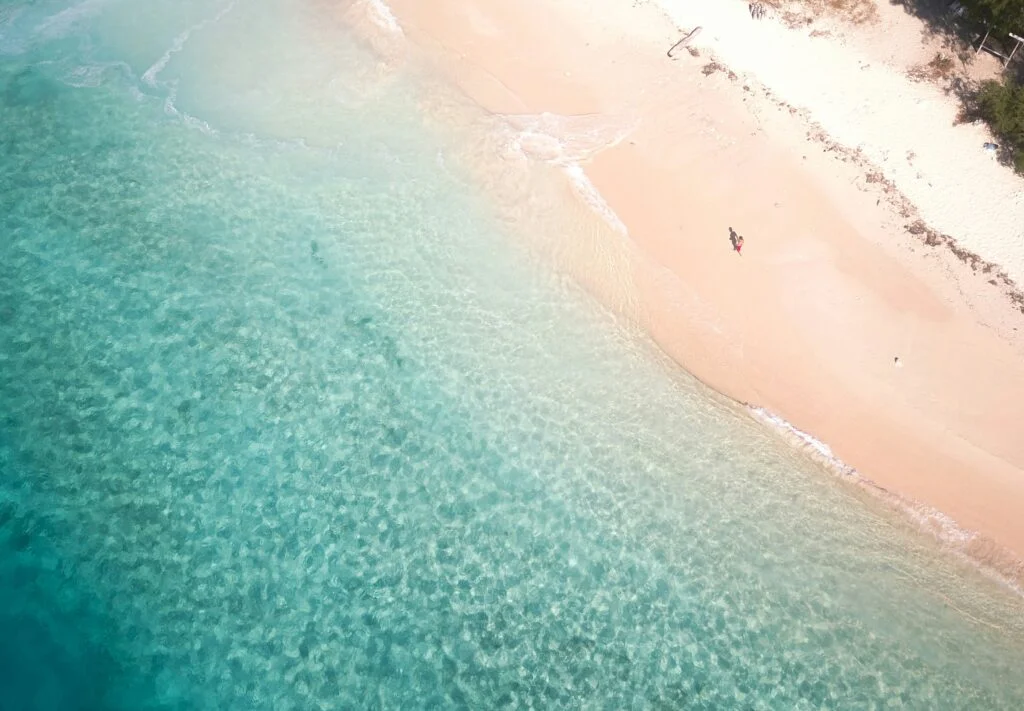
Most visitors to Saint-Martin know Orient Bay, Baie Rouge, Long Bay, Mullet Bay, Grand-Case. These are the great historic beaches, often beautiful but frequented. Beyond, the island hides about fifteen secret beaches, some accessible on foot after a short trail, others only by boat. These are the ones our clients favour.
French side: Happy Bay, Rouge, Anse Marcel north
Happy Bay is just north of Friar’s Bay, a ten-minute walk on a coastal path. White sand beach, clear water, a few coconut palms for shade, a mixed clientele often including naturists in late afternoon. The absence of road access makes it a particularly preserved beach.
Baie Rouge, the largest beach of the north coast, alternates very frequented portions with almost deserted sections at the extremities. The western portion, towards the small rocky bridge, remains quiet even in high season. A few businesses offer lounger and parasol rental with service, allowing one to spend a day without any prior organisation.
Anse Marcel has two beaches, the northern one being the most confidential. Accessible only via the road that crosses the hotel domain, it offers a very protected bay, ideal for children and for relaxed afternoons. A one-hour walk at the top of the cliff leads to Petit Caye beach, accessible only on foot — perhaps the most secret of the French beaches of Saint-Martin.
Dutch side: Plum Bay and Cupecoy Cove
Plum Bay, south of Terres Basses, is one of the most beautiful beaches on the south-west coast. Accessible via the main road then a short path, it is distinguished by its isolation and fine sand. The cove faces west, making it a privileged place for end-of-day moments facing the sunset.
Cupecoy Cove, better known as Cupecoy Beach, is discovered between two spectacular rock formations that protect it both from wind and from view. It is a natural beach, without amenities, where one comes for the beauty of the setting. Tides modify its appearance — at high tide, the beach shrinks; at low tide, it extends for several hundred metres. One section is traditionally frequented by naturists.
Protected islets: Tintamarre, Pinel, Caye Verte
Three islets near the north-east coast complete the parc of confidential beaches. Tintamarre, the largest, uninhabited, welcomes a kilometre-long white sand beach and translucent water. The island is classified as a natural reserve — no construction, no commerce, not even a cabin. Those who spend the day bring their own picnic or arrive via a private boat that plans lunch.
Pinel is smaller but accessible by public shuttle every ten minutes (or by private boat for more intimacy). Two or three small beach restaurants offer simple lunches with grilled lobster and fish of the day. Caye Verte, even more modest, remains accessible only by small craft and offers almost absolute isolation.
« Saint-Martin gives itself to those who look. The island is complete, but its most beautiful secrets hide on the seashore, at the end of a path, on an islet reached by boat. » — Maison Silaïa
The lolos: Saint-Martin’s culinary soul
A lolo is a traditional Creole restaurant, simple in form, demanding in flavour. Charcoal grills, fish of the day, accras, johnny cakes, Creole rice, red beans, sauce chien that wakes everything up, chicken feet as a bite. The cooking happens before you, often on a makeshift barbecue; tables are painted wood, chairs plastic, cutlery arriving with the order. Nothing sophisticated, everything authentic.
Lolos are Saint-Martin’s culinary soul. They embody a tradition shared with Guadeloupe, Martinique, and other French-speaking Creole islands — but here, on this small island, they have become an institution that even the most refined clients of Michelin-starred tables visit regularly.
Grand-Case: the gourmet capital
Grand-Case, a small fishing village turned the island’s gastronomic capital, concentrates the highest density of lolos. The Grand-Case Beach Club and its surroundings welcome a lineup of cabins where one dines with feet almost in the sand. Sky’s the Limit serves the island’s best pork ribs. Talk of the Town offers grilled seafood whose reputation extends to Saint-Barth. Calmos Café, further west in the village, offers a more intimate atmosphere with a small private beach.
During the Mardis de Grand-Case, the lolos open simultaneously, the main street closes to traffic, and the village becomes an immense gastronomic celebration until midnight. It is one of the most authentic moments of the year on the island — to experience at least once, and for our clients who return each season, a tradition.
Marigot, Saint-James, and French-side Creole addresses
Beyond Grand-Case, Marigot (French capital of the island) offers its fish market in the morning and its Creole restaurants in the evening. Chez Aurore, in Saint-James, is considered by many as the island’s best lolo — people come from afar for its grilled fish and conch in sauce chien. Le Tropicana, on Marigot’s waterfront, maintains a more classic tradition with bay views and guaranteed sunsets.
Dutch side: Philipsburg, Simpson Bay, Grand Pond
On the Dutch side, the lolo tradition appears in a more hybrid form, influenced by the Dutch and English-speaking Antilles. Top Carrot in Simpson Bay, Big Fish in Grand Pond, Scott’s Bar & Grill near Maho Beach — these addresses offer a more international version but keep the lolo spirit: grills, fish, reasonable prices, convivial atmosphere. Johnny B Under the Tree, in Cole Bay, is an institution for those wanting to experience popular Caribbean atmosphere in its purest form.
Navigating to these addresses: boat, 4×4, discretion
The true richness of these addresses lies in the combination between beaches and lolos — spending the morning at Tintamarre or Pinel, lunching at a lolo in Grand-Case, returning in the afternoon to Happy Bay, dining in the heights of Anse Marcel. This choreography requires logistics our clients prefer entrusting to a dedicated team.
Private boat: the key to the island
Renting a private boat for the day, with captain, transforms the Saint-Martin experience. A vessel of eight to twelve metres allows reaching Tintamarre, Pinel, Caye Verte, Anguilla (fifteen minutes away) or Saint-Barthélemy (an hour away) without time constraint. Our panel of partners includes companies established for several decades on the island — Random Wind (classic sailboat), The Edge (fast boat), several private catamarans. Typical day: departure at nine, swimming stop, lunch at Tintamarre or Pinel, snorkelling break, return around four.
4×4 or chauffeured car for terrestrial beaches
For beaches accessible by car then on foot, the 4×4 with driver offers freedom without constraint. Our preferred partner on the island provides recent vehicles with bilingual drivers who know every access, every trail, every improvised parking. They handle coolers, parasols, towels. For a day at Happy Bay, Plum Bay or Baie Rouge, it is the smoothest formula.
The discretion that makes everything
Saint-Martin is an island that lends itself to discretion if one goes about it well. Adapted schedules to avoid attendance peaks (arriving at Orient Bay at nine before cruise excursions, arriving at Pinel after their departure), firm reservations in lolos not to wait, small details like a seaside table reserved at Grand-Case with specific sunset view. These nuances, seemingly minor, make the difference between an endured day and a composed one. The bespoke experiences we compose hold precisely at this level of attention.
« A lolo is not a restaurant. It is a story to taste, a tradition to share, a moment no palace can reproduce. » — Maison Silaïa
The Maison Silaïa method for composing your days
A well-lived stay in Saint-Martin follows a simple logic: a base of accommodation chosen per intention (private villa for families, charm hotel for couples, combination with Saint-Barth for longer stays), then à la carte days composed per desires, weather, rhythm.
Our local teams coordinate each day upstream: targeted beach with preferred timing, boat reservation if needed, driver briefed, lolo reserved, return time to villa. For clients wishing total improvisation, we prepare each day a selection of options available to decline per morning desire.
The perfect combination for a discovery week: two days at the villa to settle, one day Tintamarre-Pinel by boat, one day Anguilla for lunch at Blanchards, one day Saint-Barth for dinner, two days confidential beaches on French and Dutch sides. This sequence offers the complete island panorama without ever enduring it.
Frequently asked questions
When to come to Saint-Martin?
High season runs from mid-December to mid-April, with ideal climate and all addresses open. May and November offer a good balance (less crowds, moderate prices). June-October is low season with significant cyclone risk in August-September. The best beach days fall between mid-November and mid-May.
Are secret beaches really deserted?
Some yes (Tintamarre weekdays, Petit Caye, Plum Bay off-peak). Others are relatively quiet at the right hours (Happy Bay before noon, Pinel late afternoon). True confidentiality often comes through the private boat formula, allowing to reach coves accessible only by sea.
How much does lunch at a lolo cost?
Typical budget between thirty and fifty euros per person depending on the lolo and appetite. Grilled lobster (when available) around forty euros. Fish of the day between twenty and thirty euros. The atmosphere and authenticity are well worth the detour, even for clients accustomed to Michelin tables.
Can one combine Saint-Martin and Saint-Barthélemy in one stay?
Yes, and it is a combination favoured by our clients. Fifteen-minute connecting flight, fifty-minute fast ferry, or two-hour private boat depending on winds. Typical stay: three to four days Saint-Barth, four to five days Saint-Martin, with one or two round-trip boat days between the two.
Can Maison Silaïa organise a complete stay in Saint-Martin?
Yes. We handle villa or hotel, dedicated driver, private boat by day per desires, reservations at lolos and Grand-Case tables, specific experiences (diving, sport fishing, helicopter flight to Anguilla). Let us speak in complete confidence about your stay.