
The question comes up regularly in our conversations with clients. Chartered private jet, NetJets or VistaJet shared ownership, Air France or Emirates first class, occasional empty leg — the choice of travel mode is never obvious, and assumptions abound. Some believe private jet is systematically superior; others that it is unjustifiable. The truth is more nuanced. Each mode of transport has its use cases, its real costs, its invisible constraints — and those who fly the most are not always those who fly exclusively private. For our clients who split their year between Saint-Barthélemy and the Mediterranean, between Luxembourg, Monaco and Dubai, air logistics matter as much as the destination. Maison Silaïa composes each journey according to the right mode, at the right hour, with the right transitions — for a poorly organised flight contaminates the entire experience that follows.
Private jet, premium commercial, fractional: understanding the options
Four major categories of premium flights present themselves to clients who wish to travel differently from the standard classes of regular airlines. Each category has its economic logic, its preferred partners, its constraints.
The first is full charter — where one rents an entire aircraft by the flight hour, with pilot and crew. It is the most flexible, fastest, most expensive per hour. The second is fractional ownership, offered by operators like NetJets, VistaJet or Flexjet: one purchases flight hours in advance, on a shared fleet, with guaranteed availability. The third category comprises premium commercial flights — First Class, private suites of Gulf carriers, Etihad’s Residence — which transform commercial flying into an experience close to private. The fourth is empty legs — repositioning flights of an already-chartered jet that must return empty — allowing access to chartered flying at considerably reduced rates, but on an imposed itinerary.
For those of our clients who fly thirty hours annually, ad-hoc charter suffices. For those flying one hundred or two hundred hours, fractional becomes relevant. For those doing six or seven long-haul round trips yearly on established commercial liaisons, commercial first class often remains the most rational choice. The right mode depends on annual volume, flexibility required, and usual itineraries.
Full charter: freedom and constraints
Charter — also called ad-hoc charter — consists of renting an entire aircraft for a specific flight. It is the most flexible mode that exists: one departs at the desired time, from the preferred airport, to the chosen destination, with the chosen passengers.
The principle and rates
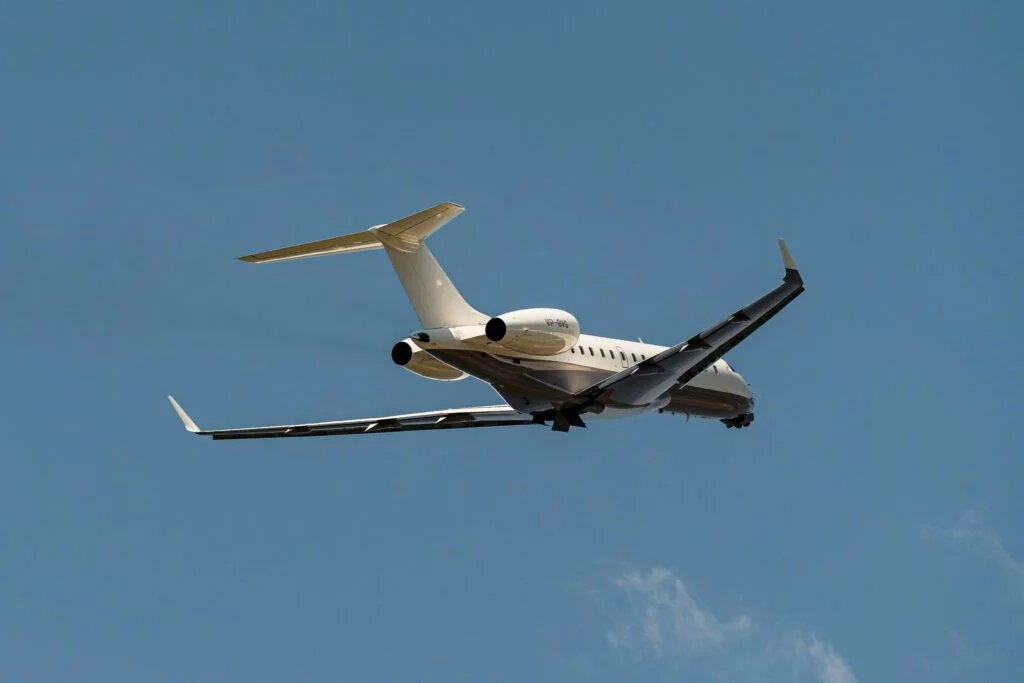
The cost of a charter is calculated per flight hour according to aircraft category. Indicatively for 2026: a light jet (Citation CJ3, Phenom 300) costs three to five thousand euros per hour; a midsize (Citation XLS, Learjet 75) five to eight thousand; a super midsize (Challenger 350, Praetor 600) eight to twelve thousand; a long-range (Global 6000, Falcon 7X, Gulfstream G650) eleven to twenty thousand. To these rates are added positioning fees if the aircraft must move from a hub to the departure airport, airport taxes, catering.
A Paris-Saint-Tropez in light jet costs about twelve to fifteen thousand euros round-trip (one hour flight each way, repositioning, taxes, catering). A Paris-Dubai in long-range costs sixty to ninety thousand euros round-trip. A Luxembourg-Saint-Barthélemy transatlantic in long-range: one hundred and forty to one hundred and eighty thousand euros round-trip.
For whom and in which cases
Charter imposes itself in several typical situations. Travel to poorly-served airports in commercial: Saint-Tropez (La Môle), Saint-Barthélemy (Gustaf III), Courchevel Altiport. Urgent or multi-leg same-day travel: Luxembourg-Geneva-Monaco-Luxembourg in one day. Group travel where the sum of premium commercial tickets exceeds the charter cost — from four to six people on long-haul. Travel with animals, bulky luggage, or security constraints. Nocturnal or early morning travel outside commercial windows.
Charter’s limits
Charter also has its constraints. Reservation delays can be short but still require several hours, sometimes a day, for a specific aircraft. Certain airports have time constraints (London City, Saint-Moritz, Nice at night). Transatlantic flights in light jets are not possible (long-range required). Weather can impose diversions that commercial airlines absorb better thanks to their networks. For our clients who travel frequently, we work with a panel of operators (NetJets, GlobeAir, VistaJet, LunaJets) that allows optimising availability and rate.
Fractional ownership: NetJets, VistaJet, Flexjet
Fractional was born in the 1980s with NetJets in the United States. The principle: one does not purchase an entire aircraft, but a fraction — equivalent to a number of annual flight hours — on a shared fleet. In exchange, the operator guarantees aircraft availability within a short timeframe (four to twelve hours depending on contract), on any route, without the uncertainties of the charter market.
The principle of co-ownership
Two models coexist. The first is true co-ownership: one actually purchases a share of an aircraft (from one-sixteenth to one-eighth depending on programmes), with a five-year commitment generally, and one pays monthly management fees plus flight hours consumed beyond the allocation. The second model is the card programmes — the most common today — where one simply purchases a block of flight hours (twenty-five, fifty, one hundred hours depending on programmes) at a fixed price, with fleet access for one year.
The programmes and their differences
Three operators dominate the global market. NetJets, a Berkshire Hathaway subsidiary, operates the largest fleet (more than seven hundred aircraft). Their European Jet Card starts at twenty-five flight hours annually for about two hundred thousand euros, with different aircraft categories depending on the chosen plan. VistaJet, European in origin, offers the Private World programme whose 2026 rates start around one hundred and fifty thousand euros for twenty-five hours — with a fleet composed exclusively of Bombardier Challenger and Global (midsize and long-range). Flexjet, more accessible on certain segments, offers interesting hybrid programmes for clients travelling primarily in Europe.
The break-even point
The comparison between ad-hoc charter and fractional depends on annual flight hours. Below fifty hours, ad-hoc charter generally remains more advantageous — especially if itineraries are variable. Between fifty and one hundred hours, fractional becomes competitive, particularly if flexibility is essential. Beyond one hundred and fifty hours, full aircraft ownership (or management by an operator of an owned aircraft) starts to be relevant — provided one accepts the associated commitment and financial exposure.
« The most expensive is not always the best. The slowest is never the rarest. The right choice depends on the journey — and on the one travelling. » — Maison Silaïa
Premium commercial cabins: First, La Première, The Residence
Regular airlines have considerably invested, over the last decade, in their premium classes. Certain private suites on long-haul now approach the experience of a private jet, at radically lower rates.
Gulf carrier suites
Emirates, Etihad, Qatar Airways have redefined premium cabins on long-haul. Emirates First Class on A380 offers an individual suite of five square metres with private minibar, queen-size bed, onboard shower. Qatar Airways offers Qsuite in Business — with a double bed for travelling as a couple in a closed suite — and a First limited to a few rotations. Etihad offers The Residence on A380 to New York, London and Sydney — a three-room apartment (lounge, bedroom, bathroom with shower) with personal butler and private chef, for thirty to fifty thousand euros per flight. These suites are among the most accomplished commercial experiences of the moment.
La Première Air France, British Airways First
Air France’s La Première — refitted some years ago with nine suites on 777-300ER — offers one of the most refined premium experiences in Europe. Flat bed, personalised service, gastronomy by Michelin-starred chefs, access to La Première salons at Paris Charles-de-Gaulle Terminal 2E. Rates range between twelve and eighteen thousand euros round-trip for long-haul destinations. British Airways First on 777 and 787 offers an equivalent alternative, with access to the private Windsor terminal at Heathrow for First passengers.
When commercial first beats the private jet
Several cases. For very long distances (more than ten hours of flight) where only high-end long-range aircraft can make the trip non-stop — Paris-Singapore, Luxembourg-Los Angeles — commercial airlines offer daily direct rotations a private jet cannot match except at five to ten times the cost. For flights where one seeks to truly sleep in flight, recent commercial suites often offer more space and comfort than a midsize jet. For journeys travelling alone or as a couple on regularly served destinations, the value-for-money is unbeatable.
For our clients, we systematically offer an honest comparison between options. The composition of your journeys includes this evaluation for each trip.
Empty legs: opportunity and constraint
An empty leg — also called repositioning flight — is a trip a private jet must make empty to reach its next mission. Rather than fly empty, operators offer these flights at reduced rates, often seventy to eighty percent less than classic charter.
The interest is obvious: one can do London-Nice in Challenger 350 for four to six thousand euros instead of fifteen to twenty thousand. Monaco-Geneva for two thousand euros instead of eight. Paris-Ibiza for three thousand euros instead of fourteen. Typical empty leg destinations correspond to the classic private jet flows: London-Nice, Geneva-Saint-Tropez, Paris-Dubai, New York-Palm Beach.
The constraints are also real. Schedules are imposed, often with short notice (twenty-four to forty-eight hours). Itineraries are fixed — impossible to deviate. Last-minute changes can cancel the flight. The flexibility that makes private jet’s charm disappears. For our clients whose calendar is sufficiently flexible, empty legs are a precious option we continuously monitor through our operator partners. For fixed-date or critical travel, empty legs are rarely the right answer.
Ground logistics: what truly distinguishes a flight
The aircraft represents only part of the journey. For our clients who fly regularly, the quality of the experience depends as much on ground logistics as on the flight itself. Three elements structure this dimension.
FBO and airport reception
An FBO (Fixed Base Operator) is a private terminal dedicated to business aviation. At Paris Le Bourget, Universal Aviation, Signature Flight Support or Jetex operate these terminals with private lounges, direct tarmac access, personalised customs processing. In Geneva, Jet Aviation and Signature FBO. In Monaco, the heliport then transfer to Nice or Cannes-Mandelieu. In London, Farnborough (quieter than Luton) and TAG Aviation. The FBO choice directly impacts ground transit time: less than fifteen minutes in a good FBO, versus two to three hours in a commercial terminal. For clients travelling in commercial first class, airlines have developed their own equivalents: British Airways’ Concorde Room at Heathrow, Lufthansa First Class terminal at Frankfurt, Qantas Private Room at Sydney.
Chauffeurs, valets, transfers
The transfer between home and airport, then between airport and final destination, is often where imperfections slip in. A dedicated car with chauffeur perfectly knowing the routes, capable of anticipating traffic constraints, is essential. For private jet arrivals in Nice or Saint-Tropez, the car waits on the tarmac. For first class arrivals at Paris Charles-de-Gaulle, the car waits at lounge exit. The chauffeur manages luggage, coordinates with FBO or crew, anticipates delays. This step often makes the difference between a serene flight and one that tips over.
Luggage, animals, children, security
Specificities of certain situations deserve anticipation. Travelling with animals implies veterinary documents (CDC for the United States, European passport for the EU) and sometimes specific constraints on carriers. Travelling with very young children requires equipment (car seats, bassinets) that some operators provide better than others. Travelling with high-value luggage (art, jewellery, couture) implies particular insurance management. Clients travelling with close security must coordinate with crew and sometimes with arrival authorities. Each specificity is worked upstream, in the continuity of the bespoke experiences we compose.
Orchestrating a journey: the Maison Silaïa method
A well-composed premium journey follows a method we systematically apply. It varies only in detail according to the chosen mode.
A detailed upstream brief
Dates, destinations, passengers, time constraints, personal preferences (food, sleep, need to work in flight), particular elements (animals, atypical luggage, protocol requirements). This brief determines the optimal mode and allows anticipation of all logistics.
An objective selection among several options
For each journey, we concretely compare two or three relevant options. Charter with three different operators (often with twenty to thirty percent rate gaps). Charter vs commercial first comparison when the liaison exists. Verification of available empty legs if dates are flexible. This comparison is done transparently with the client, with real costs and implications of each option.
Pre-confirmed point-by-point logistics
Chauffeur tested on schedules and route, FBO chosen and briefed, crew selected to match preferences, bespoke catering, destination chauffeur confirmed, hotel or villa informed of precise arrival time. Each element is validated the day before the flight.
Accompaniment during and after the flight
Real-time flight tracking, alerts in case of delay or diversion, coordination with destination chauffeur to adapt to unforeseen events, connection management if the trip includes several segments. For our most frequent flying clients, we maintain an up-to-date file of preferences that allows being ready in fifteen minutes for any journey.
« A perfect flight is one of which one keeps no memory. Everything happened as it should, when it should. » — Maison Silaïa
Frequently asked questions
How much does a private jet flight cost?
Cost depends on aircraft category and flight duration. A light jet costs three to five thousand euros per hour; a midsize five to eight thousand; a super midsize eight to twelve thousand; a long-range eleven to twenty thousand. Indicatively: a Paris-Saint-Tropez round-trip in light jet costs twelve to fifteen thousand euros; a Paris-Dubai in long-range, sixty to ninety thousand.
NetJets, VistaJet or Flexjet: what are the differences?
NetJets operates the largest global fleet (Jet Card from two hundred thousand euros for twenty-five hours). VistaJet is exclusively midsize and long-range (from one hundred and fifty thousand euros for twenty-five hours). Flexjet proposes hybrid formulas suited to short European trips. The right choice depends on itinerary type, annual flight volume, and aircraft preferences.
When does commercial first class beat the private jet?
On very long routes (more than ten hours) where airlines offer direct rotations a jet cannot match, on destinations regularly served by premium suites (Emirates First, Qatar Qsuite, La Première Air France, Etihad’s The Residence), and on couple travel without group constraints. Value-for-money is unbeatable, often five to ten times cheaper than an equivalent charter.
Empty legs: real opportunity or trap?
Real opportunity if the calendar is flexible. Empty legs allow access to chartered flying up to eighty percent cheaper than classic rates — London-Nice at five thousand euros instead of twenty thousand for example. A trap however if dates are critical, as flights can be cancelled or modified according to operator repositioning needs.
Can Maison Silaïa organise all types of flights?
Yes. We work with a panel of charter operators (NetJets, VistaJet, GlobeAir, LunaJets, Jetfly), commercial airlines (Air France La Première, British Airways First, Emirates, Qatar, Etihad), and FBO providers at major European, American and Gulf airports. We compose each journey according to the optimal mode for each client and trip, with integrated ground logistics. Let us speak in complete confidence about your project.