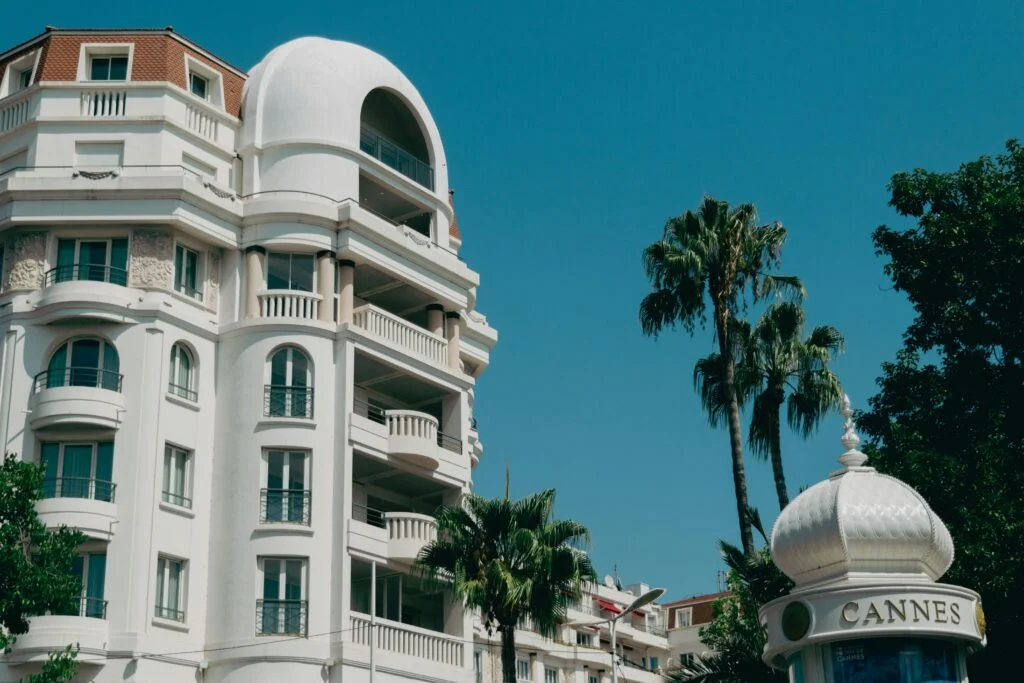

Twelve days. Two kilometres of waterfront. An industry, an art form, a parallel economy converging on the Croisette from 12 to 23 May 2026. The Cannes Film Festival is not a festival in the way others are. It is an institution, an ecosystem, an ephemeral capital where the fate of a film, the direction of a studio, the emergence of a talent and dozens of conversations that no press release will ever capture are all played out simultaneously. For our clients who divide their year between Saint-Barthélemy and the Mediterranean, these twelve days are a score to be deciphered. The red carpet is visible from anywhere in the world; the rest belongs to those who know where to position themselves, when to sit down, and when to disappear. Maison Silaïa composes these Festivals as one composes a scene: with attention, measure, and a keen sense of what takes place behind the curtain.
Cannes 2026: the twelve days that matter
The seventy-ninth edition of the Cannes Film Festival runs from Tuesday 12 to Saturday 23 May 2026. Twelve days exactly — a duration carefully calibrated to accommodate the main competition, the Marché du Film running in parallel, the parallel selections — Un Certain Regard, the Critics’ Week, the Directors’ Fortnight — and the infinite number of satellite engagements that constitute the real reason most people are there at all.
In the public imagination, Cannes is a film festival. In the minds of professionals, it is the world’s largest market for audiovisual rights. More than fifteen thousand accredited guests gather to present, negotiate, sell, co-produce, raise funds and discover the teams of years to come. American studios come to scout European talent; Asian producers sign distribution rights; streaming platforms compete for arthouse films. Behind every visible festival-goer, five others are working in an apartment on the rue d’Antibes or in a private lounge at the Marché.
It is this dual nature — public showcase and the world’s most concentrated professional salon — that makes Cannes singular. For our clients who come for their love of cinema, for the social dimension, for patronage or for investment, the real challenge is navigating between these two planes. Being present at the right moments on the Croisette, invisible at others. Knowing how to position oneself within the relevant circles, without being consumed by the official schedule.
To come to Cannes as a tourist is to leave exhausted, without having understood what was truly at stake. To arrive prepared is to leave with three or four conversations that will shape your decisions for the next eighteen months.
« Cannes is not visited — it is frequented. Twelve days where the Croisette becomes a stage, where every address is a room, and where one performs without rehearsal. » — Maison Silaïa
The geography of the Festival: knowing where to be and when
The Festival plays out on a reduced stage — two kilometres of coastline, a few perpendicular streets, a few elevated neighbourhoods — but each space has its function, its hour, its codes. To know this geography is already to have the advantage.
The Croisette: a permanent theatre
From the Palais to the Martinez, from the Hôtel Majestic to the Carlton, the Croisette is the visible stage of the Festival. This is where the red-carpet ascents unfold, the impromptu interviews, the orchestrated crowd moments. It is also where everyone crosses paths — and where, precisely, nothing of substance is said. The real conversations begin one floor above, in the private suites of the grand hotels, or slightly apart, in the confidential salons of the palaces.
The Palais des Festivals and its invisible invitations
The Palais is the cathedral of the Festival. The Grande Salle Lumière hosts the competition screenings; the Salle Debussy accommodates the parallel selections; the annexe rooms serve the Marché du Film. Gaining access requires accreditation — professional, official, or VIP — and knowing which screenings truly matter. Not all projections are equal: some are industry events, others are protocol moments, others still are the occasions where rumour is tested. Our clients who take part in red-carpet premieres do so knowing the precise stakes of each screening.
The Marché du Film: the backstage of business
Installed within the Palais and its annexes, the Marché du Film is a world unto itself. Fifteen thousand professionals, six hundred stands, thousands of confidential meetings. This is where half the world’s distribution contracts are signed. For a cinema investor, a producer or a client accompanying a project, the Marché is the true centrepiece of a Festival week. Our teams pre-position meetings with the relevant interlocutors, manage logistics between venues, and organise the informal dimension — dinners, cocktails — that extends commercial discussions.
The heights of Super Cannes and Mougins: the private stage
Above the Croisette, the elevated neighbourhoods shift in role. Super Cannes, La Californie, the hills above Mougins — these areas host the villas rented for the week by studios, investment funds, and independent producers. This is where private dinners, strategic meetings and parties that set the whole Croisette talking take place — with no photographer permitted inside. To be invited supposes being introduced. To be the host supposes having prepared the villa, its staff, its calendar, months in advance.
The evenings that truly count
The Festival is played out in the evening. Screenings fill the days; conversations occupy the nights. Three categories of evening compose this second Festival — the one that appears in no official programme.
Dinners hosted by majors and independent producers
Every studio — the American majors, the leading French groups, the Asian houses — organises one or several dinners during the week. Independent producers do the same on a more intimate scale. These dinners take place in private villas, in privatised hotel salons, sometimes on private beaches at midnight. An invitation is not obtained on request: it is built. For our clients interested in cinema through patronage, investment or simply informed curiosity, our work is to prepare the ecosystem of relationships that makes these invitations possible.
Yachts: floating offices of the week
The Bay of Cannes fills, during Festival week, with some fifty yachts of considerable size. Most are chartered for the week by studios, funds and distributors. They serve as floating offices by day — meetings in the main saloon, private screenings on the upper deck, recruitment interviews in the cabins — and as party venues by night. Each yacht has its reputation, its invitation protocols, its atmosphere. Experiencing the week from a yacht, whether as owner or privileged guest, fundamentally changes the nature of the Festival.
After-parties and their secret geographies
Once the dinners conclude, the Festival enters its third night. The private clubs of the Croisette district, the private suites of the palaces, a handful of confidential addresses in Mougins and Valbonne: this is where conversations unravel, agreements form and breaks are consummated. These venues appear on no programme. To enter supposes being recognised or introduced. Our clients who wish to access them benefit from discreet support, which we compose within the framework of orchestrating your private evenings: a driver available at any hour, a parallel exit for a partner wishing to retire, a suite prepared for the return.
Accommodation during the Festival: the art of positioning
The geography of your accommodation determines your Festival. Between a palace on the front line, a villa in the heights or a yacht in the bay, each configuration offers a radically different experience.
The historic palaces and their constraints
Four addresses structure the Croisette: the Majestic Barrière, the Carlton, the Martinez and the Grand Hyatt Cannes Hôtel Martinez. All are fully booked within twelve months of the Festival. The most sought-after suites — those overlooking the sea, those opening onto the Croisette, the penthouses — are reserved from one edition to the next by the same studios, producers, and wealthy families. Accessing these suites during the Festival requires either being informed very early, or activating a network of contacts who release their reservation at the last moment. We know the rare windows of availability and the channels that allow access.
Villas in Super Cannes and Cap d’Antibes
On the heights, or towards Cap d’Antibes, the exceptional villa portfolio constitutes the most coveted alternative — though the most demanding to prepare. A villa of six to twelve bedrooms, a full household team (chef, housekeeper, majordomo, chauffeur, security), a garden with pool, sometimes a private beach: the setting is ideal for entertaining, for discreet meetings, for genuine sleep after the long nights. The rental is negotiated ten to twelve months before the Festival, with a minimum two-week commitment, and requires concierge intervention before, during and after the stay.
Yachts at anchor
Residing on a yacht anchored in the bay, or along the Quai Albert-Édouard, offers a rare combination: intimacy, flexibility and the ability to entertain without leaving one’s own roof. Yachts can hold a dinner for eighteen in the evening, accommodate three private screenings the following day, and weigh anchor to dine at sea before returning. This configuration requires precise logistics — a tender, a valet on the quay, a helicopter for longer transfers — which our teams compose for clients who opt for this formula.
Access to screenings: the invisible codes
Behind each screening lies a precise social geography, tacit codes, access rules that no official website details. Understanding these codes transforms a presence at the Festival from a social exercise into a genuinely cinematic experience.
The grand premieres at the Palais
The premieres of competition films take place in the Grande Salle Lumière, generally at seven in the evening. Protocol is strict: evening dress required, arrival at a fixed time, a supervised red-carpet ascent, numbered seating. The ritual is photographed from around the world, making it one of the most visible moments of the Festival — and one of the most precisely timed. Accreditation alone is not sufficient: one must be on the screening list, which supposes an introduction by a distribution house, a production team or an official partner.
Market screenings and parallel selections
At the heart of the Marché du Film, several hundred screenings take place daily — completed films, works in post-production, pilot versions. These sessions are more informal, open to Marché accreditation holders, sometimes without a badge for those invited by the distributor. This is where one discovers in advance the films that will define the season, where a project’s reception is tested, where one meets the relevant teams. The Critics’ Week and the Directors’ Fortnight, two selections parallel to the official Festival, also hold their screenings in more intimate venues — and often, artistically, more stimulating ones.
Private screenings organised by distributors
Outside the official programme, distributors organise confidential screenings in privatised palace screening rooms, in villas in the hills, sometimes aboard a yacht equipped with a projection suite. These sessions present a film to a restricted circle — potential investors, select press, priority buyers. To be invited depends entirely on the positioning one has built in advance.
« A successful Cannes Film Festival comes down to one sentence: being at the right evening, at the right moment, without forcing it. Everything else is arrangement. » — Maison Silaïa
Preparing your visit: the Maison Silaïa method
A mastered Festival de Cannes is not improvised. We compose each stay according to a proven method, structured in four stages.
A confidential brief to define the intention
The first stage is a detailed two-to-three-hour exchange, conducted in the strictest confidence. What is the intention: patronage, investment, artistic curiosity, strategic presence, a combination of several? Which screenings are essential, which people must be met, which evenings must not be missed? Each answer shapes what follows.
Pre-positioning six to eight weeks in advance
For the Festival, the preparation window is tighter than for other events — not through oversight, but because the definitive programme is only revealed from mid-April. From the moment the official selection is announced, we activate our network: distribution houses, studio press attachés, production teams, circles of regular Festival-goers. Invitations are solicited, screenings selected, dinners negotiated.
Bespoke logistics, tested and pre-confirmed
Accommodation reserved, helicopter or jet from the departure airport, a dedicated driver with precise knowledge of the Croisette and its access points, a tender if accommodation is a yacht, a water taxi for evenings held offshore, a rapid shuttle between the villa in the heights and the Palais, evening attire and accessories prepared in advance in the suite or villa. Nothing is left to improvisation.
Support that is present and invisible
Throughout the twelve days, a single point of contact remains reachable at any hour. She adjusts the agenda in real time, manages last-minute invitations, secures the table no one else can obtain, keeps a driver waiting without anyone noticing. This support is part of the continuity of the bespoke experiences we compose throughout the year for our clients.
Frequently asked questions
When and where does the Cannes Film Festival 2026 take place?
The Cannes Film Festival 2026 — seventy-ninth edition — runs from Tuesday 12 to Saturday 23 May 2026, at the Palais des Festivals et des Congrès in Cannes and all official satellite venues.
Do you need to work in cinema to experience the Festival fully?
No. The Festival is primarily a professional market, but it welcomes a significant share of cinema lovers, patrons, investors and personalities attending for the social dimension or artistic interest. The question is not one of professional status, but of which circles one moves in during the week. Maison Silaïa composes these circles in advance according to the intentions of each client.
How many days should I plan to experience the Festival without being overwhelmed?
To capture the essence of the edition, three to four well-prepared days suffice — generally the first week, the most intense for red-carpet moments and opening-night parties. Those who are fully invested — in patronage, a competition project, or an industry presence — stay for the full twelve days. Fewer than three days risks experiencing only a superficial Festival.
Where should I stay during the Festival?
The palaces on the Croisette must be booked within the year preceding the Festival. The villas of Super Cannes or Cap d’Antibes offer superior intimacy but must be negotiated ten to twelve months in advance. Yachts anchored in the bay or along the Quai Albert-Édouard are the most flexible option. Our teams identify and secure the right formula according to your intentions and desired pace.
Can Maison Silaïa compose a complete stay for the Festival?
Yes. We take care of everything: selected and reserved accommodation, private logistics (helicopter, chauffeur, water taxi), access to screenings, orchestration of evenings and dinners, attire and event preparation, discreet support throughout the week. Let us speak in complete confidence about your project.