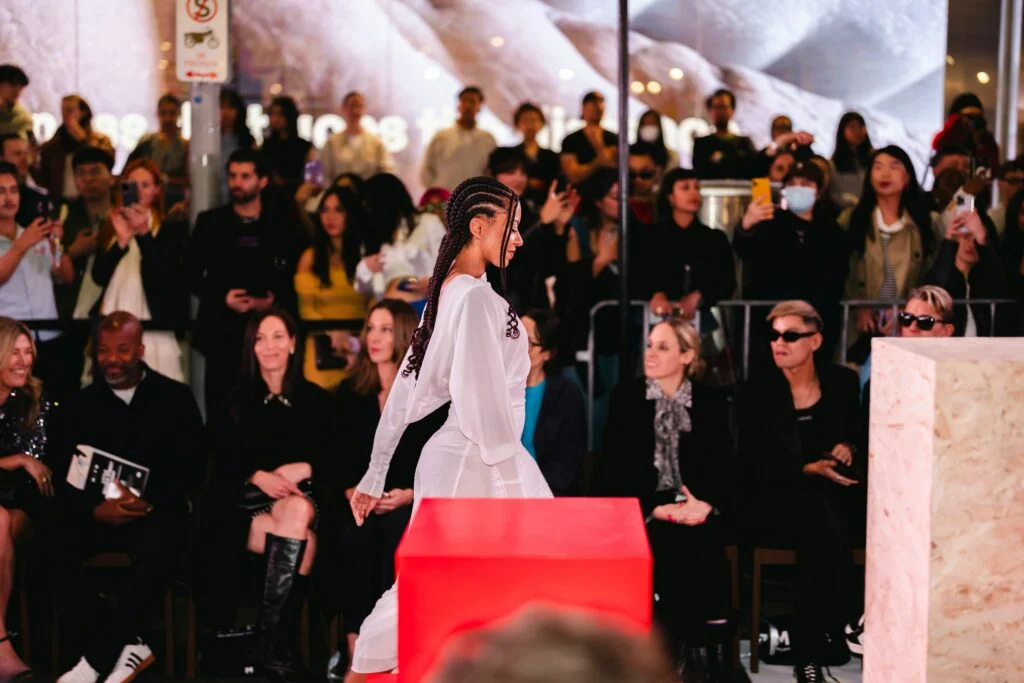
Eight days in September and October. Ninety official shows, dozens of parallel presentations, an incalculable number of dinners, cocktails, pop-up stores, fittings, private salons. Paris Fashion Week Women’s Spring/Summer 2027 takes place from 28 September to 6 October 2026 — and during these eight days, the French capital becomes the final stage of the four major fashion weeks worldwide, following New York, London and Milan. For our clients who split their year between Saint-Barthélemy and the Mediterranean, Parisian Fashion Week represents a moment apart: one of the rare occasions when Paris tells itself through a precise grammar — that of the houses, the ateliers, the inheritances transmitted there for two centuries. Maison Silaïa composes this week with the attention it demands: bespoke, millimetre-precise, and respectful enough to leave space for the unforeseen.
Paris Fashion Week 2026: the worldwide rendezvous of fashion
Parisian Fashion Week is the fourth and last of the major fashion weeks of the season. New York opens it in mid-September, London takes over, Milan follows, and Paris closes with eight days that condense — through the prestige of the houses showing there, through the density of buyers present, through the editorial force of international journalists who concentrate their attention there — what the three preceding capitals prepared.
For Women’s Spring/Summer 2027, the official week runs from Monday 28 September to Tuesday 6 October 2026. Around ninety houses present their collections within the calendar of the Fédération de la Haute Couture et de la Mode — the great historic houses (Chanel, Dior, Saint Laurent, Givenchy, Balmain, Celine), the Italian houses rooted in Paris (Valentino, Schiaparelli), and the emerging houses identified in previous seasons. To this are added dozens of parallel, off-calendar presentations that multiply year on year.
What distinguishes Paris from the three preceding weeks is less the number of shows than the quality of the ritual. The historic houses present in heritage venues — the Grand Palais when open, the Jardins des Tuileries, the Petit Palais, the private mansions of the Marais. Invitations are strictly controlled. Editors of international magazines concentrate there their most intense week of the year. Buyers of the great houses make the decisions that will orient their collections for the eighteen months to come.
For our clients who follow fashion through passion, through collection, through membership of a circle of houses, or through simple insider’s interest, Parisian Fashion Week offers an experience without equivalent. The real luxury consists in living it at one’s own tempo rather than being absorbed by the official mechanism.
« Paris is not a city: it is a grammar. During Fashion Week, each street becomes a sentence, each salon a nuance. » — Maison Silaïa
Eight days, two Parisian geographies
Fashion Week unfolds on two geographies that coexist without merging. One, classically Parisian and official: the Golden Triangle, Avenue Montaigne, Faubourg Saint-Honoré, Place Vendôme. The other, more recent, to the east: the Marais, the Haut Marais, the Gaîté quarter, Belleville in parts. Understanding this bipolarity means knowing where to place each day.
The Golden Triangle, heart of the historic houses
Avenue Montaigne, George V, Faubourg Saint-Honoré, Rue Saint-Honoré, Place Vendôme: this is the geographical map that the historic houses of French couture have drawn over the last one hundred and fifty years. Chanel at 31 rue Cambon, Dior at 30 Montaigne, Givenchy, Schiaparelli, Balmain, Louis Vuitton, Saint Laurent, Celine, Hermès, Cartier: all occupy ateliers, parent houses, private salons in this zone. Most shows connected to them are held in historic private mansions — the Palais Galliera, the Hôtel de Crillon, sometimes even in the salons of the parent houses themselves — or in the major heritage venues: Grand Palais Éphémère, Tuileries, Musée Rodin.
Movement in this triangle during Fashion Week is a challenge. The narrow streets between the Concorde and the rond-point of the Champs become saturated. Approaches to the houses are monitored. The dedicated driver becomes indispensable. For our clients, we organise in advance the day’s itineraries — which streets, which hours, which VIP accesses — to transform journeys into useful time rather than waiting.
The Marais and Eastern Paris: emerging designers and contemporary shows
Over the last fifteen years, a second Fashion Week has deployed to the east of Paris. Rue Vieille-du-Temple, rue de Sévigné, rue des Archives, the Haut Marais, rue Charlot: this is where the emerging houses present, the designers working outside the historic frameworks, the collectives. The venues are more intimate — eighteenth-century private mansions converted, showrooms, galleries — but the codes are as strict, if not more so. The Palais de Tokyo, the Couvent des Cordeliers, the Pavillon Cambon also concentrate certain presentations.
For our clients, alternating between the two zones is the hallmark of a well-composed Fashion Week. Morning on Avenue Montaigne, lunch at Le Meurice, afternoon in the Marais, dinner in a historic private mansion. Journeys between the two zones, by driver, take twenty to forty minutes depending on the hour.
Accessing the shows: the codes to know
Not all shows are equal, and not all accesses are equal either. Knowing the hierarchy of invitations means understanding what one actually sees.
Official shows: invitation and protocol
Official shows of the historic houses are strictly by invitation. Invitations are sent by the house, three to five weeks before the show, and cannot be transferred. Three levels of access structure the room: front row (first line, privileged guests — ambassadors, major clients of the house, editors-in-chief), second and third rows (regular clients, buyers, guests of press attachés), and subsequent rows (broader press, industry professionals). Front row is not requested: it is earned through a long-standing relationship with the house, or prepared through a team that knows the press attachés personally.
For our clients who are clients of these houses, we activate in advance the relationships they already maintain with the commercial teams and press attachés. For those wishing to enter these circles, we compose the preparation across several seasons — for this level of access is not built in a single invitation.
Private shows and previews
Alongside official shows, the great houses organise private presentations in their ateliers or parent houses. These presentations last one to two hours, with a restricted number of guests (fifteen to forty people), and allow a detailed reading of the collection, often accompanied by a presentation from the artistic director herself. These moments are rare. They are reserved for the priority clients of the house.
Post-show dinners and the week’s parties
Each house organises one or more dinners alongside its show. They take place in exceptional venues: private mansions rented for the evening, palaces privatised, ateliers transformed for the night. Dior dinners at the Musée Rodin, Chanel evenings at the Grand Palais when open, Saint Laurent dinners in the private mansions of the 7th arrondissement: each is a moment that is transmitted. The orchestration of your private evenings during Fashion Week requires upstream preparation — introductions, invitations, logistics — that we compose weeks before the week begins.
Where to stay during Fashion Week
Accommodation during Fashion Week is rarer and more expensive than for any other Parisian period, Roland Garros included. The palaces of the Golden Triangle close nine to ten months before the official week. The most sought-after suites — those overlooking the Champs, those opening onto the Golden Triangle, the penthouses with rooftop views — are booked from one edition to the next by the same clients.
Historic palaces
Four addresses structure the high-end offering of the Golden Triangle: Hôtel Plaza Athénée, Four Seasons Hotel George V, Bristol Paris, Hôtel de Crillon. To these palaces are added the Ritz Place Vendôme, the Mandarin Oriental rue Saint-Honoré, the Peninsula Avenue Kléber, the Park Hyatt Vendôme. All offer immediate proximity to the main shows. All are full upon opening of reservations. For our clients, we activate in advance the channels that give access to the preferred suites — relationships with management, last-minute releases, reservation transfers.
Private apartments and mansions
For longer stays or family configurations, several arrondissements offer high-standing private apartments: apartment-floors in the Haussmannian buildings of the 7th, 8th or 16th; private mansions rented for the week in the Marais or the Saint-Germain quarter. This formula allows one to host, to organise private dinners, to retain the intimacy a palace never quite offers during Fashion Week. The rental is negotiated six to eight months in advance, with dedicated concierge service for the duration of the stay.
More confidential hotels
Beyond the grand palaces, a few smaller hotels offer a precious alternative: the Saint James Paris (the capital’s only château-hotel), the Hôtel Particulier Montmartre, the Relais Christine, the Hôtel du Petit Moulin in the Marais. These addresses lend themselves poorly to receptions, but offer an intimacy that the central palaces cannot. For those of our clients preferring total discretion, these hotels often constitute the best response.
The logistics of a Parisian week
Living Fashion Week without enduring it is first a matter of logistics. Movements, fittings, rest — each element articulates with those before and after. A poorly prepared week becomes a succession of waits; a well-prepared week unfolds as a choreography.
Transfers and access protocols
Transport during Fashion Week is by chauffeured car — preferably discreet sedan, no visible signage, fine knowledge of alternative routes. The chauffeur waits during each show. She knows the probable exit hour, the best place to wait, the shortcut to take next. Access protocols to shows vary by house: some require the car to drop at the entrance, others prefer a drop point one hundred metres from the venue to avoid congestion. These subtleties are learned season after season.
Fittings and appointments in the houses
Alongside public shows, major clients of the great houses benefit from private appointments in the salons — fittings for personal orders, presentations of collections before they reach the boutiques, meetings with the artistic directors. These appointments last from forty minutes to two hours, depending on the intensity of the relationship with the house. They are booked weeks in advance and fit between the public shows with millimetre precision.
Wellness and rest between two days
An intense Fashion Week leaves little recovery time. Days often begin at eight in the morning with an initial atelier breakfast, continue with four to six shows, a lunch, more shows, a dinner, sometimes a party that extends until dawn. To sustain eight days at this rhythm, wellness management becomes critical. In-suite treatments, pilates or yoga coach at the start of the day, osteopath available in early evening: these services are composed in advance and reserved for the entire stay. They make the week sustainable without degrading one’s image.
Preparing your visit: the Maison Silaïa method
A mastered Fashion Week is prepared two to three months in advance. We compose each stay according to a proven method, in four movements.
A confidential brief to set the intention
The first stage is a conversation of two to three hours, conducted in the strictest confidence. Which houses, which shows, which introductions are you seeking to prepare? Do you wish to secure front row at a specific house, or rather capture the variety of trends? Do certain dinners matter to you? The intention decides everything.
Pre-positioning upon announcement of the calendar
The official Fashion Week calendar is published around six weeks before the week. Upon its publication, we activate our address book — press attachés of the houses, magazine editors, dinner organisers — to secure invitations, private appointments, access to parallel events.
Bespoke logistics, tested and pre-confirmed
Accommodation selected and reserved, arrival in Paris by private jet at Le Bourget or Orly, dedicated chauffeur for the entire stay, hairdresser and make-up artist in-suite, fitting appointments organised in the houses, reservations at the great tables (Ducasse at the Plaza, L’Ambroisie, Pierre Gagnaire, Arpège), access to private clubs, wellness coach, security if necessary. Each element is prepared in advance, in the continuity of the bespoke experiences we compose throughout the year.
A presence that is both attentive and invisible
During the eight days, a single dedicated contact remains reachable at any hour. She adjusts the agenda in real time, shifts an appointment, retrieves an outfit at a couturier’s, arranges an impromptu dinner, has what is missing delivered. Her presence is not felt; her absence would be immediately perceived.
« Parisian Fashion Week is judged on two things: the way one arrives at the show, and the way one leaves. » — Maison Silaïa
Frequently asked questions
When does Paris Fashion Week 2026 take place?
Paris Fashion Week Women’s Spring/Summer 2027 takes place from Monday 28 September to Tuesday 6 October 2026. The official calendar is published around six weeks before the week by the Fédération de la Haute Couture et de la Mode. The other editions of the year are Women’s Fall/Winter in February-March, Men’s Fall in January, and Men’s Spring in June.
How does one access the official shows?
Official shows are strictly by invitation. Invitations are sent by the houses three to five weeks before each show and cannot be transferred. Access to front row is built through a long-standing relationship with the house, often across several seasons. Maison Silaïa accompanies her clients in the preparation of these accesses, via the press attachés and commercial teams of the houses.
What is the difference between PFW and the Milan or New York weeks?
New York opens the cycle and concentrates American houses and commerce. London is the most experimental, open to emerging designers. Milan is the capital of leather, historic Italian houses and ready-to-wear. Paris closes the season and concentrates couture houses, major heritage shows and the highest density of international buyers. The four weeks complement each other more than they compete.
Where to stay during Fashion Week?
The palaces of the Golden Triangle — Plaza Athénée, Four Seasons George V, Bristol, Crillon, Ritz — are full nine to ten months before the week. Private apartments in the fine arrondissements (7th, 8th, 16th) and private mansions in the Marais offer alternatives with more intimacy. Maison Silaïa identifies and reserves the formula best suited to the intention of the stay.
Can Maison Silaïa organise a complete stay during Fashion Week?
Yes. Maison Silaïa takes charge of the entire stay: accommodation, private transfers, dedicated chauffeur, access to shows and invitations to dinners, organisation of fittings in the houses, hair and make-up at home, wellness services, discreet security, accompaniment throughout the eight days. Let us speak in complete confidence about your project.