
There are islands one visits, and others one learns to inhabit. Saint-Barthélemy belongs firmly to the second. Fewer than twenty-five square kilometres of volcanic land set in the turquoise waters of the Lesser Antilles, a collection of arid hills and finely cut coves, a population counted in thousands rather than hundreds of thousands — Saint-Barth is an island that must be earned, and one that rewards those who know how to read it.
Preparing a Saint-Barthélemy luxury stay is not a matter of choosing a hotel and booking a flight. The island operates by its own codes: an intimate geography, a precise seasonality, a circle of addresses regulars exchange without ever committing to print. The difference between a beautiful trip and an exceptional one is most often decided in details invisible at first glance — the villa chosen for the way its terrace faces the sunset, the table booked three months in advance for the right week in January, the boat chartered to reach an islet where one will be alone.
This guide gathers what we believe is useful to know before unpacking in Saint-Barth. It is written for those who expect a destination to return exactly the level of expectation they bring to it — and who prefer the quiet of a considered reading to the noisier promise of a tourist brochure.
- Understanding Saint-Barthélemy before you arrive
- When to visit Saint-Barth: the insider’s calendar
- Where to stay: private villas, signature hotels, confidential houses
- The beaches: a sensitive map of a jewel
- Dining in Saint-Barth: a way of life
- Signature experiences: what no guide will tell you
- Arriving in Saint-Barth: the logistics of a graceful arrival
- Shopping, galleries and encounters: the island’s other face
- Orchestrating your stay with Maison Silaïa
- Frequently asked questions
Understanding Saint-Barthélemy before you arrive
A geography to read like an address book
Saint-Barth resembles no other Caribbean island. Where Martinique unfolds its tropical forests and Guadeloupe its volcanoes, Saint-Barthélemy cultivates an almost unexpected Mediterranean aridity. The hills are dry, dressed in low scrub that recalls the back country of Ibiza or Mykonos. It is an island of winds, raw light and long perspectives.
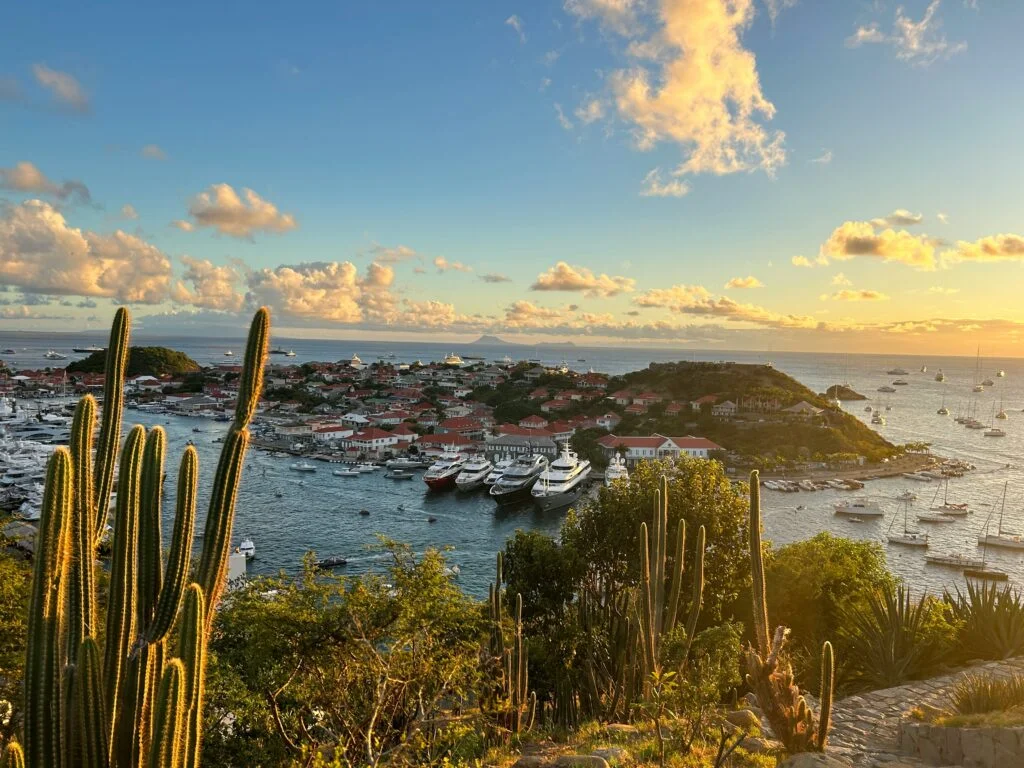
This geography reads like an address book. Gustavia, the capital, curls around its harbour and concentrates the boutiques, the tables and the daytime life. Saint-Jean, facing the legendary landing strip, has the sunnier energy of a seaside resort. Lorient retains a village charm. To the south, Saline and Gouverneur shelter the island’s two most beautiful public beaches, protected by their relative isolation. To the east, Toiny and Grand Cul-de-Sac offer a wilder, windswept, almost austere face. Each sector has its tonality, its rhythm, its ideal hour — and choosing one’s anchor on the island is already to sketch the colour of one’s stay.
A discreet ecosystem, a loyal clientele
The singularity of Saint-Barth lies as much in its geography as in its sociology. The island has always chosen rarity over volume. No mega-resort, no mass cruise calls, no tour operator unloading clients by the hundred. Capacity is deliberately limited, and most visitors return — year after year, sometimes for decades.
The result is an ecosystem where almost everyone knows everyone: the villa owners, the hotel directors, the chefs, the captains, the shopkeepers. This intimacy is one of the most precious luxuries Saint-Barth offers. It also presumes that one knows how to be introduced. The best tables at the right hours, villas available before they are ever listed, experiences that exist officially on no website — all of this is played out in a network found neither through a search engine nor through a conventional travel agency.
What Saint-Barth is not (and why that matters)
It is worth knowing what Saint-Barthélemy is not. It is not an all-inclusive island, nor a mass-tourism destination, nor a Caribbean Dubai. One does not come here for excess but for measure. The architecture is low, the signage discreet, the soundscape hushed. Even the most spectacular houses settle into the vegetation rather than rising above it. Even the most imposing yachts in Gustavia’s harbour cede the stage to the ridgeline that closes the horizon.
It is precisely this refusal of ostentation that gives the island its value in the eyes of an international clientele accustomed to everything. Saint-Barth offers what money, elsewhere, struggles to buy: stillness, the right distance, the feeling of being somewhere one can lower one’s guard.
When to visit Saint-Barth: the insider’s calendar
The choice of season is undoubtedly the first structuring decision of a Saint-Barthélemy luxury stay. The island wears three faces across the year, and each addresses a different kind of journey.
High season (December to April): the magic and its constraints
From mid-December to late April, Saint-Barth lives its golden season. Trade winds cool the afternoons, temperatures hover between 26 and 29 degrees, the water is crystalline. This is when the island unfolds its finest energy — tables fully booked, villas all taken, Gustavia harbour bristling with the most spectacular masts of the moment.
That magic has its reverse. The best villas are reserved up to twelve months in advance. Exceptional restaurants are full weeks ahead on the sought-after slots. Helicopter transfers from Saint-Martin can tighten on certain windows. New Year’s week, in particular, is a world apart: multiplied rates, availability locked down months ahead, private dinners conceived as events. One must anticipate — or entrust that anticipation to those who do it for a living.
Shoulder season (May, June, November): our quiet recommendation
May, June and November are, to our mind, the most beautiful months for anyone wishing to experience Saint-Barth in its most accomplished form. The climate remains excellent — when the rains come, they are brief and welcome. Rates settle to more reasonable levels. Villas open up. Tables welcome with renewed availability. The island breathes.
This is the season we recommend to clients discovering Saint-Barth and wishing for an accurate reading of it, without the gentle social buzz of high season. It is also the best period for longer stays, family retreats, or quiet working trips, far from the constraints of European or American capitals.
The weeks worth knowing
A handful of moments structure the year and deserve to be marked on the calendar — or, conversely, carefully avoided, depending on the kind of stay one is seeking. The year-end holidays concentrate the highest density of events, private dinners and celebrations; it is the most spectacular week but also the most demanding to orchestrate. Les Voiles de Saint-Barth, in April, turns the island into the world capital of classic sailing and draws a connoisseur clientele. The Saint-Barth Music Festival, in January, offers evenings of rare intimacy in Gustavia’s Anglican church. Finally, the Bucket Regatta, in late March, remains one of the season’s most beautiful gatherings of classic yachts. These weeks deserve to be targeted, or avoided, according to the colour one wishes to give one’s stay.
Where to stay: private villas, signature hotels, confidential houses
The question of accommodation is not secondary in Saint-Barth — it is structural. For a single villa, two stays can be radically different depending on the orientation, the proximity of a beach, the quality of the staff that comes with the house. The island offers three principal registers of lodging, and the right choice depends as much on the profile of the journey as on the number of travellers.
Renting a villa: the most accomplished experience
For a stay of a week or more, or for a journey with family or close friends, renting a villa remains, without debate, the most fitting option. Saint-Barth counts several hundred private villas, from the charming residence for a couple to the ten-bedroom estate with infinity pool, tennis court and full staff.
To rent a villa is to rent a way of life: breakfast served facing the sea at the hour one chooses, a private chef for an intimate dinner, a housekeeper who learns the occupants’ habits by the third visit. The difficulty lies in the opacity of the market. Many of the most beautiful villas appear on no public site. They are reserved through private channels, sometimes directly with the owner, often several months in advance. The choice is not made on a photograph: it is made on a fine understanding of the house, the neighbourhood, the microclimate, and the team that comes with it. We devote a dedicated guide to the most exclusive villas of Saint-Barthélemy for those wishing to go further on this point.
The island’s signature hotels
For a shorter stay, or for those who prefer the impeccable mechanics of a hotel, Saint-Barth aligns a remarkably small collection of signature addresses — and that scarcity is precisely what gives them their value.
Rosewood Le Guanahani, recently renovated, occupies one of the island’s most beautiful peninsulas at Grand Cul-de-Sac. Cheval Blanc St-Barth Isle de France, on Flamands beach, embodies a very accomplished French elegance. Eden Rock, perched on its Saint-Jean promontory, remains the island’s iconic address, with its cottages turned toward the bay. Le Barthélemy Hotel & Spa, also at Grand Cul-de-Sac, offers a more contemporary experience. Le Sereno, finally, cultivates a distinctly pared-back, Mediterranean style.
These houses do not resemble each other. They do not aim for the same experience nor the same clientele. The right choice depends on what one is looking for — the view, the service, the beach, the atmosphere — and on an attentive reading of the moment within the season.
How to choose for your stay
A few principles help in deciding. For a honeymoon or a short romantic stay, a signature hotel brings the lightness of a well-rehearsed service and the freedom not to think about anything. For a journey with family or friends, the villa imposes itself for the space, the intimacy and the possibility of personalising every meal and every day. For a long stay — two weeks, a month — the villa is again more fitting, both for comfort and for true anchoring in the life of the island. And for stays blending business with leisure, we often recommend a hybrid approach: a villa as base, with access to a partner hotel’s dining and spa.
The beaches: a sensitive map of a jewel
Saint-Barth counts some fifteen beaches, all open to the public — the island has no private beach in the legal sense. What changes, on the other hand, is the way one reaches them, the hour one chooses, and what one does there. An iconic beach on a Tuesday at eleven has nothing in common with the same beach on a Saturday at four. Reading this sensitive map is already to taste what Saint-Barth offers that is most singular.
The iconic beaches and their right moments
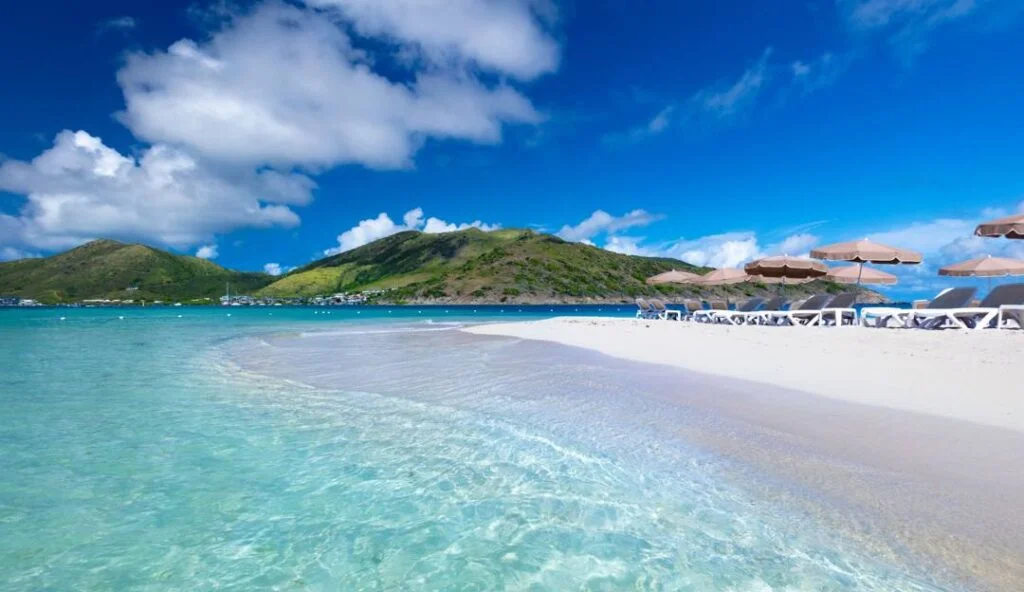
Saline remains, for many, the island’s most beautiful beach. Sheltered by a dune that hides it from view, it must be earned by a small path that extends the promise. The sand is blond, the sea crystalline, the atmosphere resolutely peaceful. Come in late morning, before the heavier heat, or in late afternoon, for the quality of the grazing light on the horizon.
Gouverneur, its southern neighbour, offers a more open bay, an even brighter sand, and the particularity of being framed by hills that shelter it from the wind. It is our beach of choice for a long, unhurried lunch, with a picnic prepared by a private chef and a parasol set up in advance.
Colombier, in the island’s north-west, is reachable only on foot via a coastal path of about twenty minutes, or by boat. This double constraint makes it one of the most preserved beaches of Saint-Barth. The water there has a particular blue, sea turtles are frequent, and arriving by sea — at anchor on a quiet weekday — remains one of the great pleasures the island can offer.
Shell Beach, in Gustavia, has an entirely different register: an urban, lively beach, perfect for a lunch facing the setting sun. Flamands offers one of the longest stretches of sand on the island, with a fine ocean presence. Lorient, more local, draws families and the early-morning surfers. Saint-Jean, finally, splits between the lively bay facing the airport and the more confidential coves that extend it.
The more confidential coves
Beyond the well-known beaches, Saint-Barth shelters a series of more discreet coves that reward those who take the time to find them. Marigot, on the north coast, remains very quiet during the week. Toiny offers a frequently animated sea but a magnificent light, set against one of the island’s most beautiful wild coasts. Petit Cul-de-Sac, at the back of a protected bay, presents a shallow lagoon ideal for families with children. Anse des Cayes, more confidential still, appeals to connoisseurs.
These addresses are best savoured midweek and in the morning. They presume that one arrives prepared — parasol, refreshments, fine towels — for on-site services are deliberately absent. It is precisely this quiet, precise logistics that distinguishes an organised day from a day endured.
Accessing « private » beaches: what is done, what is asked for
If Saint-Barth has no private beach in the strict sense, certain stretches of shoreline can indeed be lived privately — through the exclusive hire of a neighbouring islet, the chartering of a yacht for the day that becomes a floating drawing-room away from any agitation, or the temporary privatisation of a beach club outside service hours. These configurations exist, are negotiated discreetly, and appear on no public rate card. They presume that one is introduced.
Dining in Saint-Barth: a way of life
If one had to single out one register in which Saint-Barth excels beyond expectation, it would probably be the table. Few islands in the world concentrate, on so small a territory, such a density of first-rank addresses. The explanation lies in the clientele: year after year, the same regulars return to the same tables, which has created an enduring level of expectation and allowed chefs of the highest calibre to settle on the island for the long term.
The exceptional tables, starred or not
Bonito, perched above Gustavia, remains a flagship address for its views of the harbour at sunset and for its very coherent Franco-South American cuisine. L’Isola, in central Gustavia, defends with constancy a refined Italian tradition with a remarkable wine list. Orega embodies an elegant Franco-Japanese encounter, in a room thought through with care. Tamarin, nestled in dense vegetation between Saline and Lorient, deploys an art of the unhurried lunch that is among the island’s great pleasures. The table at Le Sereno, signed by a starred chef, offers one of the season’s most accomplished dinners. At Cheval Blanc, La Case proposes a signature cuisine fully in keeping with the house’s heritage.
These tables are not all equivalent for every occasion or every season. Some are perfect for a dinner for two, others for a dinner for twelve. Some require booking weeks ahead in high season; others can be approached more freely. We devote a dedicated guide to the tables and gastronomic addresses of Saint-Barth for those who wish to have its full cartography.
Beach lunches, a local institution
The beach lunch is to Saint-Barth what lunch on Pampelonne is to Saint-Tropez — an institution, but with a more hushed, more Caribbean tonality, less turned toward seeing and being seen. Nikki Beach, on Saint-Jean bay, remains a reference for its particular energy and its lingering tables. Shellona, on Shell Beach in Gustavia, offers a finely judged Greek cuisine facing the sunset. La Plage, also at Saint-Jean, embodies the relaxed elegance of lunch with one’s feet in the sand.
These addresses live by the island’s rhythm: one settles in around one in the afternoon, sometimes stays until late, and invariably crosses paths with regulars. Booking the right table — front row, in the shade of a palm, away from the passage — makes all the difference, and is decided well before the day itself.
Private chefs and bespoke dinners
Beyond the restaurants, the true singularity of dining in Saint-Barth is lived at home. The island counts an ecosystem of private chefs of the highest level — some from starred houses, others specialised in a particular register, all capable of designing a dinner in perfect dialogue with the occasion, the hosts’ tastes and the house receiving them. A dinner prepared by a private chef on a villa terrace, facing the sunset, with an orchestrated service and a cellar curated for the evening, remains one of the most memorable experiences Saint-Barth can offer.
This kind of organisation presumes upstream work: the choice of chef in line with the desired style, the validation of menus, the sourcing of ingredients — sometimes shipped from Europe for very specific requests — the coordination of service, the pairing of wines. It is precisely the kind of orchestration in which we intervene for our clients.
Signature experiences: what no guide will tell you
Beyond beaches and tables, Saint-Barth shelters a series of experiences that appear on no guide, precisely because they are not arranged as a circuit but bespoke, case by case, in step with the wishes and availability of the moment.
Sea: day yachts, neighbouring islets, private diving
The sea, evidently, remains the theatre of the finest days. Chartering a yacht for the day radically transforms one’s experience of the island: one leaves Gustavia mid-morning, sails toward the neighbouring islets — Île Chevreau, Île Fourchue, Île Frégate — anchors for a lunch prepared on board, swims in waters that no road reaches, and returns to harbour in the gentle late-afternoon light.
The formulas vary by boat size, by crew, by the gastronomy on board. A weekday on a mid-sized yacht, with a captain who knows the passes and the discreet moorings intimately, remains one of the most beautiful ways to understand Saint-Barth. Diving, for the initiated, is arranged at precise spots — Gros Îlets, Pain de Sucre — with private guides so as to avoid any traffic.
Land: confidential walks, ateliers and encounters
One thinks less of Saint-Barth for its land walks, and yet. The Colombier coastal path, the one linking Petit Cul-de-Sac to Grand Fond, or the ascent of Morne Vitet at sunrise, offer perspectives one would not suspect from the beaches.
The island also lends itself to more intimate moments: an encounter with a Gustavia craftsman in his workshop, a private gallery visit outside opening hours, a confidential photography session at a spot chosen for the light of the moment. These experiences have no published rate. They are composed on request, with interlocutors who agree to open their doors to a precisely chosen clientele.
Wellbeing: in-villa treatments, exceptional practitioners
Wellbeing, in Saint-Barth, is not necessarily lived in spas — though the signature hotels host some very beautiful ones. It is lived above all at home. The island’s best practitioners — massage therapists, osteopaths, yoga teachers, pilates coaches, internationally trained estheticians — travel to villas. A treatment given facing the sea, on a terrace ventilated by the trade winds, takes on a dimension one will not find in any cabin. These practitioners are not found on booking platforms: they are recommended from one regular to another, and their appointment book fills quickly in high season.
Arriving in Saint-Barth: the logistics of a graceful arrival
Saint-Barthélemy has no international airport. One does not land here directly from Paris, London, Geneva or New York. This is both a constraint and, let us say it, part of its protection: the island must be earned, and these access logistics naturally act as a filter. Well orchestrated, the arrival in Saint-Barth becomes a stage of the journey; poorly prepared, it can weigh on the first hours of the stay. A handful of simple principles allow it to be lived well.
Private jet, commercial flight, helicopter from Saint-Martin
Three main routes lead to Saint-Barth. The first, the most direct, is the private jet landing at Saint-Jean airport. The runway, short and technical, only accepts aircraft certified for its use and pilots specifically qualified — which narrows the choice but guarantees a controlled arrival.
The second option, the most common, is to reach Saint-Barth from Princess Juliana International Airport, in Saint-Martin, after a long-haul flight. From there, the helicopter remains the smoothest transfer: fifteen minutes of spectacular flight over the channel separating the two islands, with a direct drop-off at Saint-Jean. The regional commercial flight covers the same connection in about ten minutes, more frequent but with slightly heavier logistics.
The third route, less used for arrival but valuable for certain configurations, is the maritime link — regular catamaran or private boat — which also connects Saint-Martin to Gustavia in about forty-five minutes. The choice between these options depends on the configuration of the journey, the volume of luggage, sensitivity to weather, and, evidently, the desired level of confidentiality. We devote a dedicated guide to private transport to Saint-Barthélemy for those wishing to understand every nuance.
Landing at Saint-Jean: what to know
The Saint-Jean runway is famous for its tight banked approach over La Tourmente hill and for its spectacular final descent. The reputation is deserved — qualified pilots form a narrow circle — but the landing itself, in experienced hands, is lived as a singular moment rather than as an ordeal.
What to know: the runway operates only by sight, between sunrise and sunset. There are no night flights and no instrument landings. This means a long-haul flight arriving in Saint-Martin late in the day will not connect immediately to Saint-Barth — one will need to plan an overnight stay, or align the long-haul arrival to remain within the operational window. It is a detail, but a structural one, worth anticipating from the design of the trip.
Transfers, cars and boats on the island
On Saint-Barth itself, mobility is essentially by car. The island is small but its roads are winding, and each journey takes a little longer than one anticipates. A rental car remains the most practical mode of getting about, with a preference for compact, slightly elevated models suited to narrow roads and tight Gustavia parking. For clients who prefer not to drive, a private chauffeur by the day or the week is a precious option, especially as he also becomes a useful local relay.
The boat, finally, should be considered a genuine mode of transport during the stay, not merely a one-off experience. A private tender can reach a Colombier lunch, an evening with friends moored in Gustavia, or an islet for the day. It is one of the most elegant ways to inhabit the island.
Shopping, galleries and encounters: the island’s other face
This dimension of Saint-Barthélemy is often underestimated. On a minuscule territory, the island concentrates a remarkable density of fashion houses, jewellers and galleries — an ecosystem built over decades for an exacting international clientele that expects, on holiday, the quality it is accustomed to in the great capitals.
Gustavia: designers, jewellers, confidential houses
By the narrowness of its streets and the discretion of its windows, Gustavia is one of the most beautiful shopping grounds in the Caribbean. The great houses keep their addresses here — Hermès, Loro Piana, Louis Vuitton, Bulgari, Cartier — in boutiques designed for a clientele in residence, often with selections specific to the island.
Alongside the historic houses, Gustavia also shelters a collection of local designers who are an integral part of Saint-Barth’s identity: Pati de Saint Barth for its t-shirts that have become a signature, Calypso for beachwear, Poupette St Barth for summer dresses, Lolita Jaca for refined summer couture. Independent jewellers — Diamond Genesis, Donna del Sol, Next — complete this landscape with pieces conceived for the Caribbean light.
The true pleasure, in Gustavia, lies in taking one’s time. The boutiques sit close to one another, one moves from a great house to a designer’s atelier in a few steps, and a well-orchestrated late morning allows a fitting, a visit to a jeweller and a lunch facing the harbour.
Saint-Jean and Lorient: a more relaxed mood
Outside Gustavia, Saint-Jean offers a lighter register, with shopping galleries — including the emblematic one at Eden Rock — and boutiques designed for spontaneous purchases on a beach day. Lorient, more local, hosts a few confidential addresses of craftsmen and designers, less visible but sometimes more interesting for those seeking pieces out of the ordinary.
Artists and galleries worth knowing
Saint-Barth finally hosts an artistic life far denser than one would imagine. Several Gustavia galleries present contemporary artists — some international, some island residents — in human-scale spaces where genuine encounter with the work remains possible. A private visit, outside opening hours, with the gallerist or sometimes the artist themselves, offers a moment that no guide can plan in advance. Here again, it is by introduction rather than reservation.
Orchestrating your stay with Maison Silaïa
Everything above can be composed on one’s own. A villa can be found, a table can be reserved, a helicopter can be chartered — and some of our clients prefer to keep their hand on these choices. Others prefer to entrust this orchestration to those who have made it their craft, to free themselves entirely from the time and mental load it represents.
It is precisely what we do in Saint-Barthélemy: an intimate reading of the island, an address book that cannot be found online, the capacity to coordinate everything upstream — villa, household team, private chef, transfers, tables, experiences — and to remain available throughout the stay for the adjustments of the moment. Our clients find in our travel and stay services a quieter, more fluid way of inhabiting Saint-Barth.
Frequently asked questions
What is the best time of year to visit Saint-Barthélemy?
High season, from December to April, offers the most consistent climate and the liveliest atmosphere on the island, at the price of much earlier anticipation and significantly higher rates. For a first stay in Saint-Barth’s most accomplished form, we often recommend May, June or November: the climate remains excellent, villas open up, tables welcome with more availability, and the island moves to a more fitting rhythm.
Should I choose a villa or a hotel in Saint-Barth?
It depends on the nature of the journey. For a stay of a few days as a couple, a signature hotel brings the lightness of a well-rehearsed service. For a journey with family or close friends, from a week onwards, the private villa imposes itself: it offers space, intimacy, and the ability to personalise each day entirely — private chef, in-villa treatments, dinners orchestrated on the terrace. For long stays, the villa remains the best option.
How do I get to Saint-Barthélemy from Europe or the United States?
There is no direct flight to Saint-Barthélemy. The three main routes are: a private jet landing directly at Saint-Jean (subject to specific pilot qualification), a long-haul flight to Saint-Martin followed by a helicopter transfer (fifteen minutes) or a regional flight (ten minutes), or a private maritime link from Saint-Martin (about forty-five minutes). The right choice depends on the configuration of the trip and the desired level of confidentiality.
Which restaurants are unmissable in Saint-Barthélemy?
Among the island’s exceptional tables, Bonito, L’Isola, Orega and Tamarin are addresses that recur among Saint-Barth regulars. The signature hotel dining rooms — La Case at Cheval Blanc, the table at Le Sereno, the restaurants at Rosewood Le Guanahani and Eden Rock — offer dining experiences of the highest order. For beach lunches, Nikki Beach, Shellona and La Plage remain institutions. In high season, reservations on sought-after slots are made several weeks ahead.
Is a private concierge worth engaging in Saint-Barth?
For a short stay in a signature hotel, the hotel’s own concierge may suffice. For a villa stay, a journey combining several locations on the island, or a high-demand period (year-end holidays, Voiles de Saint-Barth), a private concierge fully comes into its own: it opens access to addresses that appear on no website, orchestrates household teams, anticipates reservations long before they become public, and coordinates everything — private chef, transfers, bespoke experiences — with full availability throughout the stay.